
Don White, ¡presente!
A Preview to my contribution to Writing Diaspora: An Evening of Poetry

Tomorrow, XMAP in collaboration with MOCA Los Angeles is presenting Writing Diaspora: An Evening of Poetry with Javier Zamora and myself. This piece below is one of the works I will be sharing. It’s a complicated homage to Don White, one of the co-founders of CISPES (Coalition in Solidarity w/the People of El Salvador). Don was a retired schoolteacher in the Los Angeles Unified School District when I first met him in 1998. He had this ebullience about him, an elfin charm that endeared him to working class Salvi exiles and organizers. I didn’t know Don that well but he helped raise funds for a revolutionary group tour of Havana I was a part of, organized by the late Jon Hillson of the Los Angeles Coalition in Solidarity With Cuba. I got to see Fidel Castro give our youth conference (on Neoliberalism and Globalization) a six-hour speech because of Don White. So every rally or fundraiser or Bus Riders Union meeting I saw him at I felt instantly better about being there. I had never met anyone like him—he struck me as queer and effeminate and I owe much of my revolutionary education to his presence. If you knew him then you might know what I am talking about but these weren’t queer spaces we were occupying as members of our respective generations coming together to undo the damages of U.S. intervention. There wasn’t much language back then but for Don was a queer touchstone in often heterosexist spaces. Don was ferociously critical of U.S. imperialism and the last cause he had devoted himself to was Palestinian liberation before he passed away in 2008. When I think about being Salvi, I think of him.
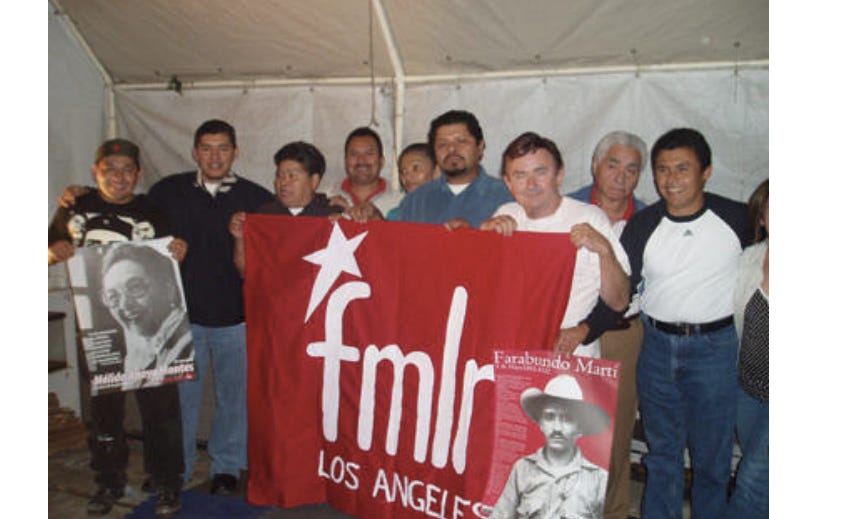
photo by Walter Lippman
Hay hombres que luchan un dia y son buenos.
Hay otros que luchan un año y son mejores.
Hay quienes luchan muchos años y son muy buenos.
Pero hay los que luchan toda la vida: esos son los imprescindibles.
- Bertolt Brecht
For Don White
What is it about the movement that helps dispel the loneliness of the closet?
How did he do it as a school teacher in an ever-embattled school district
as is the one in Los Angeles?
Who was he who brought his love, his hope, and his dreams for liberated world
into the classroom
into the meeting space
into the streets, into the protests
into the strategy sessions.
Was he involved in more the dangerous activities,
the adrenaline spiking in the early hours of dawn,
behind the scenes, did he know the arms runners?
Did he know who killed Roque?
The more intensely proximate to violence type of company arrows.
How did he find love?
Where did he find love?
Was he out cruising the boulevards looking for comfort in the arms of brown men?
Did the people he loved so much know about his proclivities?
Is it fair to speculate?
He struggled for our people every day and he was good.
Is it wrong to assign him a site of desire, even when desire is what fueled his desire,
where politics fueled a desire for a just world, a world he could belong to sitting behind us, where we could enjoy the view of the world at the expense of his sightline.
Is there a way he put his desire into the movement?
He was an effeminate, a singular gender that had no name,
when acts were designated by churches, there was no time
to free our bodies when Reagan was bombing the soul out of Perquin y Chalate
but he, the indispensible one, he carried himself as fully himself.
He had the most terrible toupeé, a vanity in need of a lift.
He had no vanity. That is how good he was.
Or did he dye his hair?
Who were his friends? Did they traffic in truth together?
He raised so much money for young people to go to the international youth conference on globalization and liberalism in Havana with the Los Angeles Coalition in solidarity with the people of Cuba. That was in 1999. The following year he yelled down the Figueroa corridor when the DNC decided to rear its head in the city of Angels.
and then he died in 2009.
Was he sick?
Was he in the hospital?
Did he die alone?
Don't we all die alone?
Do the good ones die alone?
Does this happen to the indispensable ones?
Don’t we all die alone in coalition with the people of El Salvador?
He was at the organizing convening in 1980 that founded the coalition in solidarity
with the people of El Salvador.
He was the face that led the coalition in solidarity with the people of El Salvador
He retired and and he was white, he was enthusiastic and he was elfin, an effeminate man who implored his kin to “get involved.” He was who he was and he was emblematic of the ones that go kamikaze hard in their actions of solidarity, these were the good ones. He had to have been a communist. He was a school teacher. All school teachers are communists and that is still the coolest thing you could be. That’s why capitalism dismisses the school teachers because that’s who seed the revolution.
How do I take my loneliness and put it into the movement?
How do I use my loneliness for good?
How do I become remembered with that Bertolt brecht adage of the good ones who struggled every day, how do I become indispensable?
In every movement
people fuck, a love hangover never slowed down anybody
and besides, every revolution is fueled
by a desire to live and to risk it all means no day is taken as given.
Every movement has its romantic dramas
and entanglements until a revolutionary,
a critical witness is spirited away in a van
riding along on a street in Pico-Union picking people off,
como zancudos en la luz
like a mistake on a test.
Be indispensable.
Take your loneliness
and put it into a movement,
never feel alone forever.
Always be in compañerismo
Is that the secret to love?
Where do you go when you don't fit in anywhere else
and when anywhere else has no sense of justice
for the world's most vulnerable most subjugated
by the forces of sociopathic capitalist imperialism?
Who wants to fit in to these places anyway?
Where do you go when you don't want to let your actions
be harnessed into the machines of productivity?
He was good because he fought.
He fought every day and every day he fought.
It was the fighting that made him good.